Customer, Employee, Vendor, Affiliate and Partner training program centralized effectively for businesses with ZohoLearn

Centralized Enterprise Learning Management (CELM) represents the strategic consolidation of all organizational training and knowledge dissemination efforts onto a singular, integrated software platform. This approach moves beyond the traditional, internally-focused corporate Learning Management System (LMS) to embrace a comprehensive strategy, often termed the Extended Enterprise, that includes all critical external stakeholders: customers, partners, affiliates, and vendors, alongside internal employees. The primary business imperative driving the shift to CELM is the realization that knowledge friction—the delay, cost, and risk associated with decentralized, inconsistent training—negatively impacts revenue, operational efficiency, compliance adherence, and ultimately, customer retention. In the fragmented digital landscape of modern business, where product complexity and regulatory demands are constantly escalating, an ad-hoc system of disparate training portals, shared drives, and manual certification tracking is a critical vulnerability.
The Zoho ecosystem, specifically anchored by Zoho Learn, offers a potent architectural blueprint for achieving this high-level centralization. Zoho Learn functions not merely as an LMS but as a foundational pillar of a wider digital ecosystem, seamlessly integrating with core business functions managed by other Zoho applications like Zoho CRM (for customer/partner tracking), Zoho People (for employee HR/compliance), and Zoho Analytics (for multi-dimensional ROI measurement). This holistic integration is what distinguishes the Zoho-based CELM model, transforming the training platform from a cost center into a strategic revenue enabler and a risk mitigation tool. For businesses seeking to scale knowledge transfer with the growth of their operations—a challenge often faced by rapidly expanding enterprises—the centralized, scalable, and customizable nature of Zoho Learn's portals provides the necessary infrastructure.
The concept of a Multi-Dimensional Learning Ecosystem (MDLE) provides the necessary theoretical and structural lens through which to view modern centralized training. An MDLE is defined not by the technology it employs, but by its capacity to serve five distinct stakeholder groups—the five core dimensions of the extended enterprise—each with unique learning objectives, content needs, and desired business outcomes. The MDLE framework necessitates a platform that can manage multiple distinct learning paths, access permissions, and branded environments from a single administrative back-end, which Zoho Learn is specifically designed to facilitate through its custom portal architecture.
Five Key Dimensions
The heterogeneity of the extended enterprise demands that the training platform dynamically adapts its content, delivery modality, and measurement metrics to the specific role of the learner. A comprehensive CELM strategy must address the individual needs of these five dimensions:
Customer: Focused on product adoption, feature utilization, and self-service support. The primary metric is Time-to-Value (TTV) and Support Deflection.
Employee: Centered on time-to-productivity, professional development, and regulatory/company compliance. Key metrics include Onboarding Cycle Time and Compliance Rates.
Vendor: Focused on standardizing supply chain or service delivery protocols, Quality Assurance (QA), and ethical compliance (e.g., ISO standards). Metrics revolve around Error Rates and Audit Pass Scores.
Affiliate: Concerned with maximizing conversion rates, understanding product positioning, and legal disclosure requirements. Metrics are directly linked to Conversion Rate Uplift and Lead Quality.
Partner: The most complex dimension, requiring in-depth Sales Enablement, technical certification, and strategic alignment on market positioning. Metrics include Certified Partner Revenue (CPR) and Channel Conflict Reduction.
The inability of disparate, siloed systems (e.g., HR-LMS for employees, a simple knowledge base for customers) to cross-reference performance data and standardize content is the fundamental flaw that the MDLE model seeks to rectify via a platform like Zoho Learn. This integration allows a Customer Success Manager to instantly identify if a customer's product utilization issues correlate with their incomplete onboarding training, a level of insight impossible without CELM. The ability to maintain a single knowledge repository (a Manual) and selectively pull chapters into different Portals or Courses is a powerful feature for maintaining content consistency while ensuring contextual relevance. For example, a core 'Product Security Protocol' article can be mandatory reading for Employees (via the Employee Portal Manual) and also be included as a lesson within the 'Partner Technical Certification' Course (via the Partner Portal).
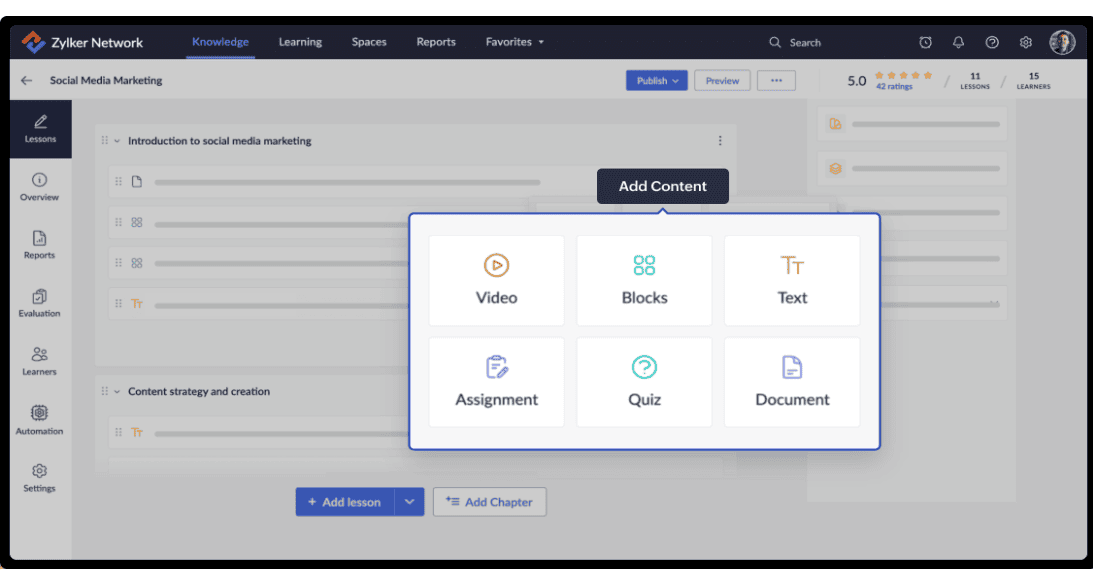
Effective Customer Training is critical in the Subscription Economy. A well-trained customer is an engaged customer, which directly correlates to higher product adoption and lower churn—the two most significant financial indicators for SaaS and subscription-based businesses.
The Strategic Imperative - Customer Success through Education
The goal of customer training is simple: ensure the user achieves their desired outcome from the product as quickly as possible. This is the Time-to-Value (TTV) metric. Zoho Learn's Custom Portals allow a business to create a professional, searchable "Customer Academy" that feels like an extension of their own brand, providing:
Self-Paced Onboarding Courses: Structured courses for new users that replace expensive, one-on-one training sessions. These should be heavily multimedia-based (video, interactive quizzes) and utilize Zoho Learn's drag-and-drop authoring tools for rapid content creation.
Just-in-Time Support Manuals: A searchable knowledge base (Manuals) integrated with the company's website or product interface. This allows a customer to search for an answer instantly before opening a support ticket.
Adoption Campaigns: Use the integration between Zoho CRM and Zoho Learn. If a customer has not utilized a key feature (tracked in CRM), an automated workflow (via Zoho Flow) can trigger an email enrollment for a specific, short training module in Zoho Learn, driving feature adoption without manual intervention.
The financial ROI here is clear: [High Authority Backlink to a Customer Success Report or Churn Analysis, e.g., Gartner Report on Customer Service and Support Technologies]. Every support ticket deflected by a self-service resource saves the cost of a human agent's time, and every percentage point drop in churn results in massive lifetime value (LTV) gains.
The Partner and Affiliate dimensions represent the indirect sales channel. Training this group is not a soft skill; it is a sales enablement function that directly affects revenue velocity and market penetration. The complexity lies in providing enough technical depth without exposing sensitive information, and ensuring compliance with pricing and brand guidelines.
The Certification Engine: Driving Partner Tiers
Zoho Learn’s Certification feature is the cornerstone of a structured Partner Program. Businesses can use the system to define multi-tiered learning paths:
Tier 1: Sales Accreditation: Focus on product positioning, value proposition, and competitor comparison. Requires a low-stakes, high-volume knowledge check.
Tier 2: Technical Certification: Deep dive into implementation, configuration, and troubleshooting. Requires a high-stakes, timed, and potentially proctored exam.
Tier 3: Master Certification: Advanced specialization in specific product areas, often requiring project submission and annual recertification.
Zoho CRM Integration: The critical link here is the automated data flow. Upon a Partner completing a Tier 2 certification in Zoho Learn, Zoho Flow can automatically update the Partner's record in Zoho CRM to "Certified: Tier 2," granting them access to higher commission rates, specialized lead pools, and exclusive content within the Partner Portal. This real-time data synchronization eliminates the administrative bottleneck often plaguing channel management.
Affiliate Compliance and Consistency
Affiliates require fast, standardized training on brand messaging, legal disclaimers, and marketing compliance. The challenge is scale and consistency. Zoho Learn provides a single source of truth for brand assets and legal requirements. Affiliates are granted access to a minimalist portal where mandatory courses (using the Mandatory Read feature) confirm they understand the rules before receiving commission payouts (data linked to Zoho Books/Zoho CRM).
Vendor Training Automation and Self-Service Solutions
Vendor training is often overlooked but is central to quality assurance and regulatory risk management, particularly in manufacturing, logistics, or sensitive data handling environments.
Quality and Protocol Standardization: Vendors can be trained on specific [High Authority Backlink to an ISO or Quality Management Standard, e.g., ISO 9001:2015 Guidelines] to ensure all inputs into the business meet a unified standard. Zoho Learn Manuals serve as the official, version-controlled Standard Operating Procedures (SOPs).
Automated Verification: The Verification Reminders feature ensures that critical SOPs and quality manuals are reviewed and verified by the content owner at defined intervals, preventing outdated protocols from causing costly errors in the supply chain. Vendors must confirm they have read the latest version, providing an auditable trail.
Compliance is non-negotiable, yet the process of tracking, documenting, and proving compliance during an audit is often a major administrative burden.
Auditable Record Keeping: Zoho Learn provides a granular, timestamped record of every user's progress, completion, and assessment result. This single source of truth is critical for demonstrating due diligence during a regulatory audit ([High Authority Backlink to an article on GDPR/CCPA or a similar regulatory requirement]).
Automated Recertification: Regulatory training often requires annual renewal. Zoho Learn allows administrators to set automatic recertification schedules. When a certification is due to expire, the system automatically re-enrolls the user and notifies their manager and HR (via Zoho People), transforming a high-risk manual process into a low-risk automated function.
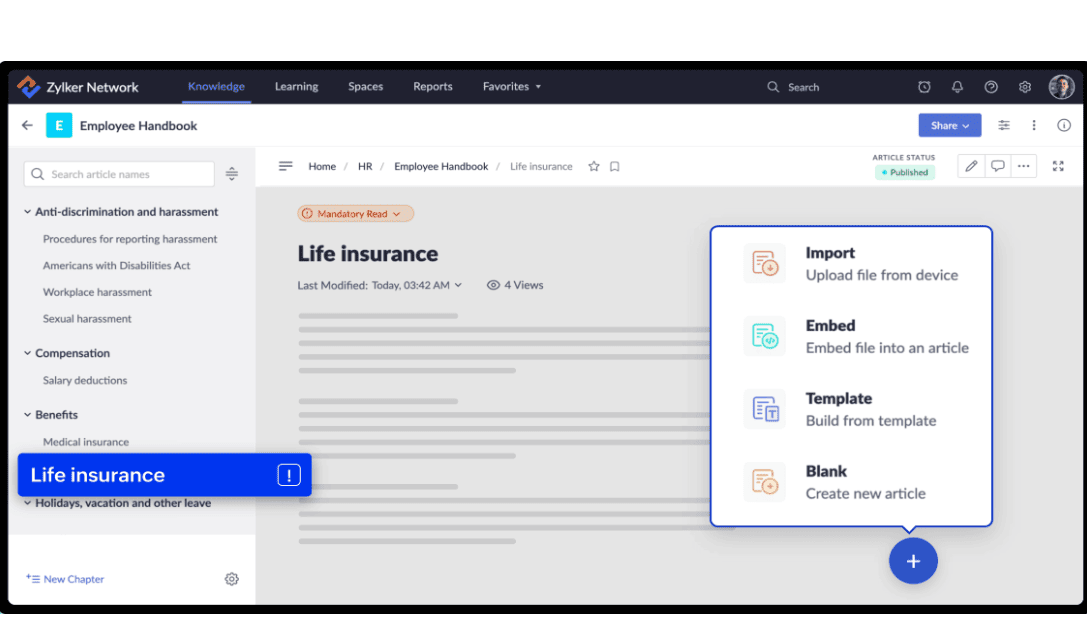
While the external dimension is revenue-focused, the internal dimension is the bedrock of operational stability, efficiency, and legal compliance. Zoho Learn acts as the unified platform for the entire employee lifecycle, from pre-hire to executive development.
Employee Onboarding - Accelerating Time-to-Productivity
The traditional employee onboarding process is often a disjointed series of forms, disparate trainings, and human-intensive interactions, resulting in slow time-to-productivity.
Pre-boarding and Day One Automation: Integrating Zoho Learn with Zoho People (the HRMS) automates the process. As soon as a candidate accepts an offer in Zoho People, they are automatically enrolled in the 'Pre-Boarding Essentials' course in Zoho Learn. On their first day, completion of the mandatory 'IT Security Policy' course unlocks access to subsequent tools.
Structured Learning Paths: Using Learning Paths—a feature that chains together multiple courses and materials—allows L&D teams to create role-specific, guided journeys. A new Sales Executive, for instance, has a path that includes: Company Culture → CRM Usage (Zoho CRM training) → Product Master Class → Sales Pitch Certification. This eliminates guesswork for both the manager and the new hire.
While Zoho Learn offers extensive customization, Zoho Creator allows Erphub to build entirely bespoke applications that wrap around the learning data for specific needs. For an Affiliate Program, a custom Creator app can pull completion data and conversion data from Zoho Learn and Zoho CRM, respectively, to create a real-time, gamified leader board. This is a powerful, novel way to drive engagement that goes beyond the native LMS capabilities. For large enterprises, an L&D manager may need a unique view combining Employee compliance data from Zoho People, Vendor quality data from Zoho Learn, and Audit dates. Zoho Learn also builds this single, executive-level Compliance Heatmap by blending data from all sources.
Zoho Learn, through its native architecture for Custom Portals, robust assessment capabilities, and fundamental integration with the wider Zoho suite (CRM, People, Flow, Analytics), provides the only truly unified, scalable, and multi-dimensional solution for a Centralized Enterprise Learning Management (CELM) system. This shift re-positions the L&D function from a traditional cost center to a verifiable strategic profit and risk management driver, allowing businesses to monetize knowledge and automate compliance across their entire ecosystem.