The execution stage of the contract is the moment of commitment, and its efficiency is directly proportional to the business's revenue velocity. Traditional execution methods introduce friction, delay, and legal ambiguity. The integration of Zoho Sign within the CLM pathway addresses these issues with clinical precision, establishing a digitally seamless and legally robust signature process.
Legal Frameworks and Non-Repudiation
A core responsibility of any e-signature solution is adherence to global legal statutes, ensuring that a digital signature holds the same legal weight as a wet-ink signature. Zoho Sign provides this assurance by complying with key international and regional regulations:
United States: Adherence to the Electronic Signatures in Global and National Commerce (ESIGN) Act and the Uniform Electronic Transactions Act (UETA). These frameworks establish that electronic records and signatures are valid and enforceable solely because they are in electronic form.
European Union: Compliance with the eIDAS Regulation (Electronic Identification, Authentication and Trust Services). eIDAS defines three levels of electronic signatures: Simple, Advanced (AES), and Qualified (QES). Zoho Sign facilitates the necessary security and identification checks to support these higher-level signatures where required, offering superior non-repudiation—the inability of a party to deny the validity of their signature.
The Microscopic Proof: The Audit Trail
The foundation of legal enforceability for an e-signature is the Audit Trail Certificate. This document is a meticulous, time-stamped log, functioning as forensic evidence of the signing event. For every transaction processed through Zoho Sign, the system automatically records and provides:
Signatory Identification: Recording of the signer’s email address and, optionally, multi-factor authentication details (e.g., OTP or access code).
Geographic and Technical Metadata: Capture of the signatory's IP address and browser/device information at the moment of signing.
Event Chronology: Detailed time stamps for every action: document sent, viewed, agreed-to-terms (disclosure), and digitally signed.
This microscopic level of data capture ensures that, in the event of a contractual dispute, the organization possesses a clear, indisputable record of the intent and process of execution, significantly mitigating legal risk.
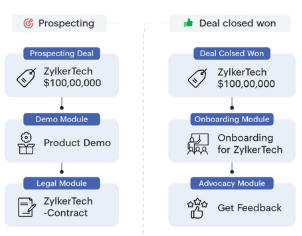
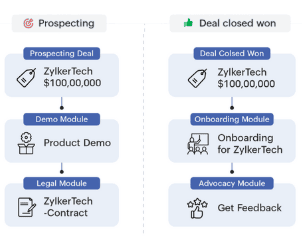
The CLM process achieves its maximum potential only when it is not an isolated function but is fully embedded within the sales workflow managed by Zoho CRM. The CRM platform acts as the central hub, leveraging the data on qualified leads (gained from the UTM-tracking to trigger, manage, and track the entire contracting sequence.
The integration eliminates the silo between the sales opportunity (the record in CRM) and the contract document (the output from Zoho Contracts).
One-Click Contract Generation: From the Deal or Account record in Zoho CRM, the sales representative can initiate the contract drafting process directly. This action triggers the automatic population of the Zoho Contracts template using the CRM data fields (e.g., product quantity, pricing, payment terms). This instantaneous, accurate data transfer maintains sales momentum.
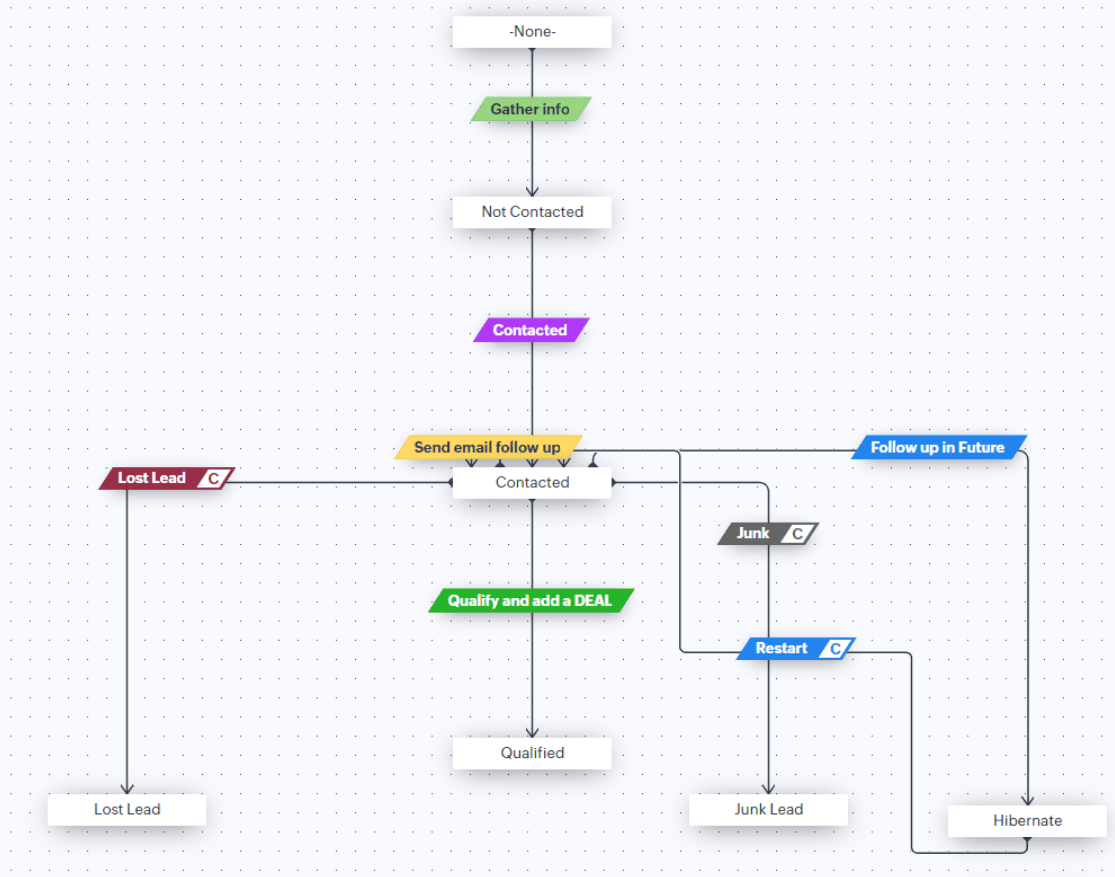
Status Synchronization: Crucially, the status of the contract is perpetually synchronized between Zoho Contracts and the relevant Zoho CRM Deal Stage. As the contract moves from 'Drafting' to 'Sent for Review,' 'Under Negotiation,' and finally 'Signed,' the CRM Deal Stage is automatically updated. This clinical synchronization ensures that the sales pipeline accurately reflects the real-time closure velocity, eliminating the common issue of 'stuck' deals and improving sales forecasting accuracy.
Document Repository and Relationship History
The executed contract is the ultimate documentation of the customer relationship. Its placement within the CRM enhances its utility.
Associated Records: Upon final execution via Zoho Sign, the fully signed contract PDF and its associated Audit Trail are automatically stored within the Attachments module of the corresponding Lead/Contact, Account, and Deal records in Zoho CRM. This ensures that every stakeholder—Sales, Support, Finance—has immediate, permission-based access to the authoritative agreement without needing to navigate external systems or request documents via email.
Historical Context: This centralized storage reinforces the concept of a single source of truth. When a customer service agent reviews an open ticket, they can instantly refer to the governing contract to understand the scope of services purchased (e.g., SLA details), enhancing customer service quality and compliance adherence.
Acceleration of the Sales Cycle and Revenue Velocity
The most direct impact is the reduction of the sales cycle duration. By eliminating manual drafting, email-based negotiation loops, and physical signing delays:
Average Contract Cycle Time (ACCT) Reduction: Organizations typically see a reduction in ACCT from weeks or days to hours. If a contract takes $N$ days to execute, and the organization executes $M$ contracts per year, the total time savings are immediately convertible into earlier revenue recognition.
Improved Sales Momentum: The time between client acceptance (verbal commitment) and legal execution is often the most vulnerable phase. Digitizing the process locks in the client commitment while enthusiasm is high, minimizing "deal slippage" and improving the ultimate sign-up conversion rate.
Enhanced Operational Compliance and Risk Reduction
The adaptation shifts the process from uncontrolled, distributed actions to a governed, automated workflow.
Compliance Enforcement: Mandatory use of pre-approved templates and automated legal routing ensures that the company's legal standards are applied to every single contract, minimizing exposure to non-standard or unauthorized clauses that could introduce risk.
Visibility into Obligations: Post-execution tracking ensures that both parties adhere to their duties. Proactively tracking milestones and obligations reduces the risk of contract default and provides early warning signs for potential client churn or dispute.
Digitizing and Simplifying the CLM
The focus shifted to integrating the contracting process into the CRM workflow.
Zoho Contracts and Template Library: The legal and sales teams collaborated to migrate all standard agreements into Zoho Contracts, establishing a library of approved, dynamic templates using merge fields.
CRM-Contracts Automation: Within Zoho CRM, a custom button was added to the Deal record labeled "Generate Contract." Clicking this button now instantly triggers the creation of the contract in Zoho Contracts, automatically populating all client and deal-specific variables (e.g., pricing tables, delivery timelines) from the CRM data. This action moves the CRM Deal Stage from 'Proposal Sent' to 'Contract Drafted.'
Integrated Execution: The negotiation and execution were confined to the Zoho Contracts environment, leveraging its version control. Once finalized, the document was routed for signing via Zoho Sign. Signatories received a secure link, executed the agreement digitally in compliance with eIDAS, and the final executed PDF, along with the full Audit Trail, was immediately and automatically stored back in the corresponding Zoho CRM Deal and Account records.
The decision to leverage the Zoho ecosystem—specifically Zoho Campaigns and Zoho Marketing Automation for data capture via UTM parameters, and Zoho Contracts and Zoho Sign for CLM execution—was instrumental in achieving a sustainable competitive advantage.
The transformation was characterized by a methodological, microscopic focus on process integrity. By standardizing UTM usage, AscendTech transitioned marketing from an opaque cost center to a scientifically measurable profit engine. By automating CLM via Zoho Contracts and CRM integration, they removed administrative friction, dramatically accelerating revenue recognition and mitigating legal risk.
Ultimately, the adaptation pathway forged by AscendTech demonstrates that modern business excellence is not achieved through siloed technology purchases, but through the deliberate, systematic integration of processes. The Zoho Unified Platform served as the architectural blueprint for this success, enabling the organization to move from operational fragmentation to a state of seamless, data-driven revenue generation. This model of systematic adaptation is not merely an optional enhancement but a fundamental requirement for any enterprise seeking sustained growth and efficiency in the digital commerce landscape.