The contemporary buyer, particularly millennials who engage with digital assistants daily, demands 24/7 availability and immediate, personalized responses. The inability of human teams to meet this expectation—especially during peak hours or off-market hours—is a primary driver of customer churn. Chatbots address this by providing continuous service and handling 75–90% of routine customer requests, allowing businesses to scale their engagement capacity globally without scaling labor costs.
Key Chatbot Engagement Statistic (2025 Trends) | Impact Dimension | Strategic Relevance |
90% of businesses report faster complaint resolution. | Service Efficiency | Boosts brand loyalty and reduces negative social feedback velocity. |
82% of customers prefer talking to a bot if waiting is involved for a human. | Availability/Friction Reduction | Eliminates wait times, the leading cause of customer frustration. |
$8 average ROI for every $1 invested in development. | Financial/Operational | Justifies capital expenditure by offsetting labor and increasing conversion. |
55% of companies report an increase in high-quality leads. | Sales/Marketing | Optimizes the top of the funnel by automated, real-time qualification. |
58% of B2B companies integrate bots (vs. 42% B2C). | Industry Trend | Proves the maturity and complexity handling capability in enterprise sales environments. |
The core mechanism for sales acceleration is proactive engagement, which relies on real-time visitor tracking and scoring. Zoho SalesIQ provides a platform where bots (Zobot) are intrinsically linked to visitor behavioral data. By defining custom triggers—such as a visitor spending more than 60 seconds on the pricing page or returning for a third time—the Zobot can launch a personalized, contextual chat offer (e.g., "Welcome back! Are you comparing pricing? I can answer any questions instantly."). Rather than simply capturing contact forms, a sophisticated Zobot (often using a codeless drag-and-drop builder or advanced Zia Skills) can execute multi-step lead qualification within the chat window. It asks pre-defined qualifying questions (budget, timeline, authority) and immediately updates the prospect's record in Zoho CRM. This process, often referred to as Conversational Marketing, results in a higher volume of warmer, more qualified leads, evidenced by the reported 3x better conversion rates compared to traditional funnels. This shifts the engagement focus from generic information provision to targeted conversion assistance.
Chatbots enhance conversion rates by guiding users through complex transactions or decision-making processes on both web platforms and mobile apps (Mobilisten SDK).
Retail/E-commerce: A Zobot, integrated with a backend inventory system (e.g., Zoho Inventory), can provide real-time product recommendations based on browsing history, handle abandoned cart follow-ups via integrated messaging apps (like WhatsApp/Facebook Messenger), and answer specific product questions (e.g., "Is this shoe available in size 10?"). In specific industries like e-commerce, this dynamic assistance drives conversion improvements up to 30%.
B2B/SaaS: Chatbots automate the crucial step of booking a demo or consultation. A Zobot flow can check the availability of a sales representative using Zoho Calendar integration, book the appointment, and update the CRM, eliminating the friction of email back-and-forth and capturing interest instantly. This immediacy is vital, as 35% of business leaders credit virtual agents for simplifying sales processes and closing deals.
In the service domain, the impact of chatbots is primarily measured in efficiency, cost reduction, and the quality of issue resolution. The goal is to maximize the containment rate—the percentage of queries resolved by the bot without human intervention—thus making service smarter for the business.
24/7 Self-Service and Instant Resolution (Zoho Desk’s Answer Bot)
Zoho Desk deploys the Answer Bot, an AI companion specifically trained on the company’s internal Knowledge Base and FAQ resources. This allows the bot to instantly deliver highly relevant, high-quality answers. The Answer Bot is the primary driver of the self-service revolution, which $81\%$ of customers now prefer to use before contacting a human.
Deep Dive: The Zia-Powered Answer Bot. The Answer Bot, enhanced by Zia's Generative AI capabilities, goes beyond keyword matching. It uses NLP to understand the user's intent, the context of the query, and even the sentiment. For example, a query like "I cannot log in after the last update" is matched not just to a static FAQ, but to a dynamic troubleshooting guide. Zia can also provide a seamless human-like conversation experience by integrating with generic models like ChatGPT, handling open-ended inquiries more gracefully while maintaining the privacy and security of internal data by limiting its access to external sources.
The Cost-Reduction ROI: By automating $75-90\%$ of Tier 1 support, the Answer Bot directly contributes to the estimated $8 billion annual cost savings projected for businesses by 2022 due to chatbot adoption. The primary ROI metric here is the Reduction in Cost Per Interaction (CPI) and the Ticket Deflection Rate.
Seamless Handover and Context Preservation
A common criticism of early chatbot implementations was the frustrating "bot loop" where complex issues could not be escalated effectively. Modern platforms, like Zoho, prioritize the seamless handover to human agents, recognizing that a chatbot's failure to resolve an issue must be handled with care to maintain customer satisfaction.
Blueprint Integration: When the Zobot/Answer Bot's confidence score drops below a threshold, or the customer explicitly requests human assistance, the conversation is routed to a live agent via Zoho SalesIQ or escalated to a ticket in Zoho Desk. Crucially, the entire chat transcript, all collected data (name, order ID, qualification scores), and the customer's sentiment are automatically pushed to the agent's workspace. This context preservation ensures the customer never has to repeat their issue, turning a potential point of failure into a positive service experience, contributing to the 96% of respondents who agree that businesses using chatbots take good care of their customers.
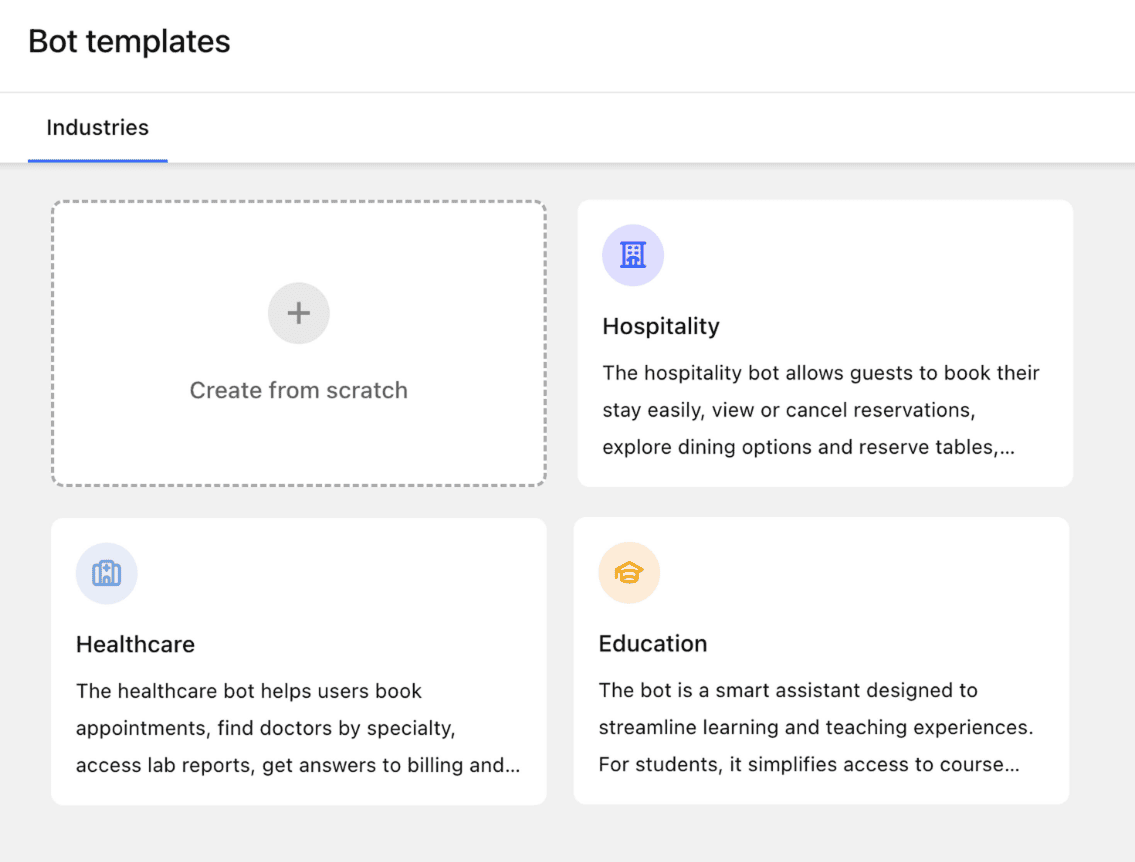
Achieving high ROI from chatbots requires a strategic, multi-dimensional implementation approach that extends beyond simple code deployment. Erphub advocates for a strategy encompassing technical, operational, and ethical dimensions.
Technical and Operational Dimensions: The Hybrid Approach
Successful enterprise chatbot deployment hinges on the Hybrid Model, which combines the speed and consistency of Rule-based/Guided Bots with the intelligence and fluidity of Conversational AI/GenAI Bots.
Deployment Model | Primary Use-Case | Zoho Implementation | Optimal ROI Driver |
Rule-Based/Guided | High-volume, structured tasks (e.g., qualification, order status, booking). | Zobot (using codeless drag-and-drop builder). | Efficiency & Speed: High containment rate for known, defined processes. |
Knowledge/Answer Bot | Information retrieval from defined, internal company documents (FAQ, KB). | Zoho Desk Answer Bot (Trained on KB articles). | Cost Reduction: Automates Tier 1 support and reduces agent time per ticket. |
Generative AI Assistant | Open-ended conversations, creative responses, sentiment analysis, agent assistance. | Zia/ChatGPT Integration in SalesIQ/Desk. | Engagement Quality: Higher customer satisfaction and better lead nurturing. |
This hybrid model allows the business to prioritize the $8 ROI from simple automations while iteratively investing in the GenAI capabilities for higher-value, more complex interactions. Large-scale deployment of chatbots involves the collection of immense volumes of customer interaction data, raising critical concerns about privacy and ethics.
GDPR and CCPA Compliance: Erphub’s approach ensures that all chatbot implementations are rigorously compliant with global data protection regulations. The use of platforms like Zoho, which prioritize user privacy and offer granular control over data storage and usage, is paramount. Chatbots must collect data transparently, securing explicit user consent for tracking and storage.
Bias Mitigation and Model Training: The performance of AI chatbots is entirely dependent on the quality and lack of bias in their training data. A continuous feedback loop, where conversations that lead to human escalation are analyzed and used to retrain the Zia/Zobot model, is essential. This ensures the chatbot's responses are accurate, fair, and continually improve, preventing mistakes that could lead to negative customer sentiment.
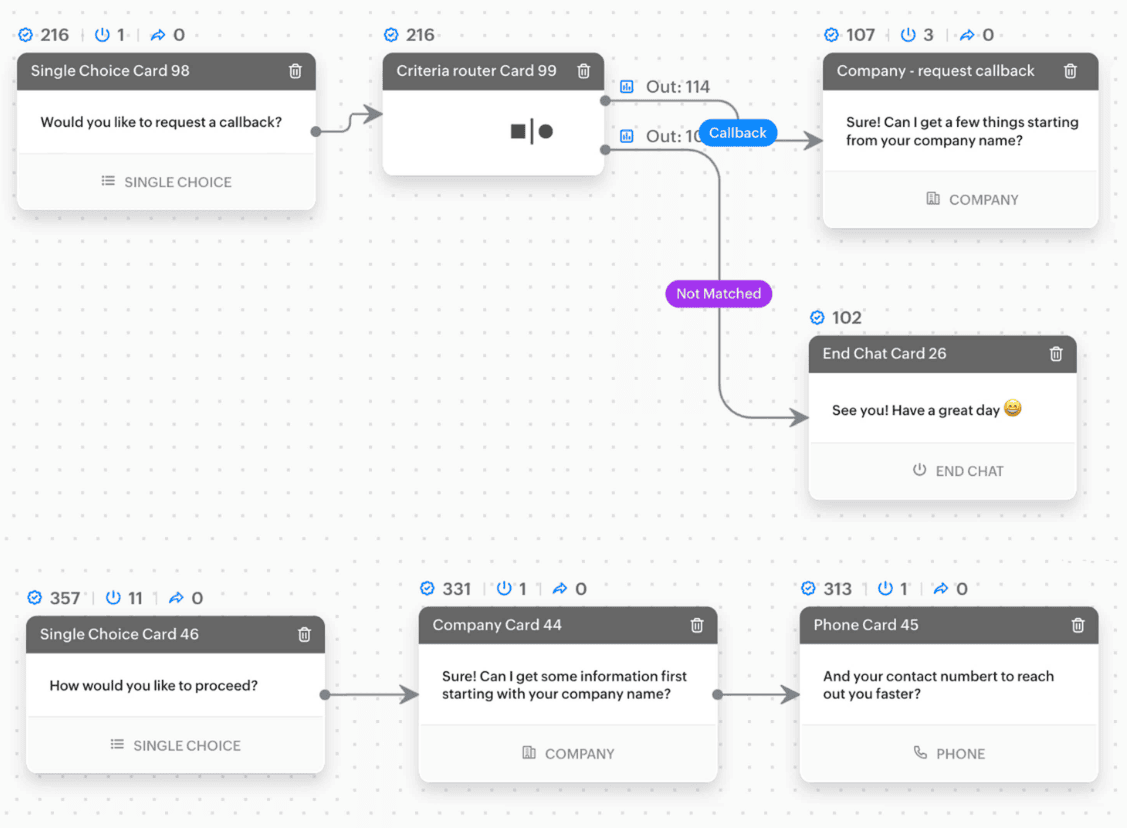
The impact of chatbot solutions on web and app-based engagement is profound, moving the needle on nearly every critical business metric—from sales conversion rates (up to 70% in some sectors) to operational cost reduction (up to 30%). The integrated Zoho ecosystem, through the complementary power of Zoho SalesIQ (for engagement and lead generation) and Zoho Desk (for service and self-resolution), provides the ideal framework for businesses seeking to deploy a sophisticated, multi-dimensional Conversational AI strategy.
By choosing a platform that offers both powerful, codeless bot builders and deep integration with CRM and helpdesk systems, Erphub's clients can transform their digital properties into perpetually available, hyper-responsive, and personalized engagement hubs. This is the Conversational Revolution—a necessary transformation for any business aiming to thrive in the instant-response economy.