The paradigm shift in modern commercial engagement has necessitated a fundamental re-evaluation of how enterprises manage customer interactions. The evolution from siloed point-solution infrastructure to cohesive, unified platforms—specifically leveraging omni-channel shared inboxes and intelligent automation—represents a critical inflection point in competitive strategy. Historically, businesses adopted a multi-channel approach, providing consumers with various interaction options (e.g., phone, email, social media) that functioned independently, often resulting in fragmented data visibility and requiring customers to repeat context across touchpoints. The subsequent development of a cross-channel model began linking these disparate systems; however, true unification is achieved only through an omni-channel architecture, wherein all communication streams are synchronized and presented within a single, contextual interface, ensuring continuity of experience regardless of the origination or destination of the contact. This strategic pivot is no longer merely a competitive advantage but an operational imperative, driven by escalating consumer expectations for personalized, seamless service. Research from high-authority sources confirms the quantifiable benefits of this unified structure: companies implementing robust omni-channel strategies report an average 89% greater year-over-year customer retention rate than those with weak strategies, and targeted campaigns across multiple integrated channels can lead to purchase rates increasing by up to 287% (Aberdeen Group; Amra & Elma). The organizational challenge, therefore, lies not in offering numerous channels, but in harmonizing the operational backend. The concept of the omni-channel shared inbox, exemplified by solutions such as Zoho TeamInbox and its tight integration with core Customer Relationship Management (CRM) and Help Desk platforms, addresses this complexity by acting as the foundational layer for unified engagement. This technological architecture is intrinsically multi-dimensional, impacting sales cycle acceleration, support efficiency, and marketing personalization simultaneously. It collapses departmental silos by offering a singular view of the customer journey, enabling any agent, regardless of their specific channel assignment, to access the complete chronological record of prior interactions, thereby fulfilling the customer expectation that the enterprise inherently understands their history. This comprehensive centralization is the precondition for activating the subsequent layer of sophisticated, tailored automations, distinguishing mere efficiency gains from genuine transformational utility. The integration capability, particularly within the Zoho ecosystem, allows the shared inbox to transition from a simple communication aggregator into a core system of record, driving better strategic decision-making and enhancing overall operational throughput.
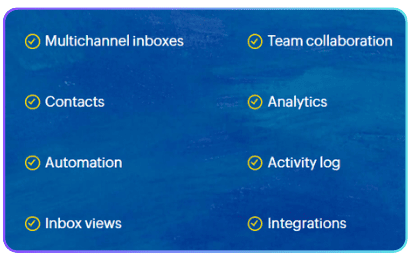
Architectural Foundations: The Shared Inbox as a Unified Data Repository
The omni-channel shared inbox functions as a critical centralized nervous system for business communication, fundamentally transforming siloed tools into a collaborative digital workspace. This architecture moves beyond the limitations of traditional group email accounts, where the lack of accountability and context often leads to duplicate replies or missed queries—a phenomenon that contributes significantly to customer dissatisfaction. In contrast, a robust solution like Zoho TeamInbox is engineered to ingest, organize, and manage diverse communication types, including standard email, social media direct messages (Facebook Messenger, Instagram DMs), WhatsApp Business messages, and third-party chat platform interactions, presenting them as unified, assignable threads. The core utility lies in its ability to enforce accountability through features like thread assignment, status tracking (Open, Pending, Closed), and transparent internal collaboration. Agents can utilize contextual internal commenting (@mentions) directly alongside the customer thread, eliminating the need for side emails or separate chat applications, a feature proven to cut average first-resolution times by up to 31% (Zendesk). The multi-dimensional advantage of this structure extends across organizational functions. For Sales teams, it centralizes inbound leads from various web and social sources, allowing for rapid qualification and assignment, ensuring that potential revenue opportunities are addressed within critical response windows. For Support, the ability to view the customer’s complete interaction history, including prior purchases logged in Zoho CRM and previous support tickets in Zoho Desk, means agents are never starting a conversation from scratch. This contextual continuity is essential, as 42% of customer service agents report being unable to efficiently resolve customer issues due to disconnected systems and archaic interfaces (Forrester). Furthermore, the unified data flow enables superior governance and compliance by centralizing audit trails and ensuring that all communication adheres to regulatory standards (e.g., GDPR, HIPAA), particularly crucial in sectors like finance and healthcare. The following table delineates the functional differences that characterize this architectural shift from basic multi-channel tools to true omni-channel utility:
Feature Dimension | Traditional Multi-channel System (e.g., Group Email) | Modern Omni-channel Shared Inbox (e.g., Zoho TeamInbox) |
Data Siloing | Conversations are fragmented by channel; context loss is high during channel switching. | Unified data ingestion; every interaction is linked to a single customer record across all channels. |
Accountability & Workflow | Manual forwarding, CC proliferation, and reliance on memory for assignment. High risk of duplicate replies. | Role-based access, explicit thread assignment, transparent status management, and SLA tracking. |
Channel Coverage | Typically limited to email and sometimes phone, with manual entry for others. | Native integration with Email, Social DMs, Messaging Apps (WhatsApp, Telegram), and CRM chat logs. |
Collaboration Method | External communication (side emails, instant messages) to discuss customer issues. | Internal, contextual Comments and private drafts nested directly within the customer thread. |
Integration Depth | Weak or non-existent links to core systems (CRM, ERP, Billing). | Deep, native integration with CRM/Desk platforms, allowing real-time data access and updating from the inbox interface. |
This cohesive data layer creates the essential groundwork for leveraging the sophisticated automation tools that define the next generation of business engagement.
Algorithmic Tailoring: Advanced Automation and Workflow Orchestration
The integration of advanced, tailored automations atop the unified omni-channel architecture serves as the primary engine for scalability, personalization, and operational efficiency. Moving beyond simple auto-responses, contemporary solutions utilize sophisticated workflow engines and embedded artificial intelligence (AI) to orchestrate complex, multi-step customer journeys. Within the Zoho suite, features like Blueprint in Zoho CRM/Desk and the cross-application workflow capabilities of Zoho Flow allow enterprises to design dynamic processes that react instantaneously to customer behavior across any channel. For instance, when an inbound message is received in the shared inbox, AI-driven sentiment analysis (such as that offered by Zoho Zia) can instantly classify the urgency and emotional tone of the query. This classification then triggers a multi-dimensional automation sequence: (1) Intelligent Assignment: The query is automatically routed to the agent with the highest relevant expertise and lowest current load, ensuring optimal service quality; (2) Contextual Data Retrieval: The automation fetches the customer's purchase history, support ticket status, and lead score from the CRM, displaying it in the agent’s unified console before they even initiate a response; and (3) Proactive Response Generation: For common Tier 1 queries, the system can draft a personalized response using pre-approved knowledge base articles, significantly accelerating resolution time. This level of algorithmic tailoring is fundamental to meeting evolving consumer demands, as studies indicate that customers who receive highly personalized experiences are 3.6 times more likely to make additional purchases (Deloitte Digital) and 74% expect the brand to inherently understand and anticipate their needs (Salesforce). Furthermore, tailored automation is crucial for Sales and Marketing alignment. A lead engaging via social media and then following up via email in the shared inbox can have their activity sequence trigger a lead nurturing workflow in the CRM. If the lead is qualified, automation can assign a high-priority task to a sales representative; if not, it can enroll them in a targeted drip marketing campaign. This prevents valuable leads from falling through the cracks—a common failure point in multi-channel environments where 61% of customers report being unable to easily switch channels without losing context (Aspect). The utility of this approach is inherently multi-dimensional, extending from minimizing operational drag by automating repetitive tasks (e.g., tagging, archival, response goal monitoring) to fundamentally enhancing the strategic value of every interaction by ensuring it is highly personalized, timely, and data-informed. The orchestrated integration across channels ensures not only consistency in messaging but also maximal efficiency in resource allocation, driving tangible increases in customer lifetime value (CLV).
Strategic Deployment, Measurement, and Future-Proofing CX Infrastructure
Successful deployment of an omni-channel shared inbox and automation strategy is contingent upon viewing the project not as a mere software upgrade, but as a holistic restructuring of the organization’s Customer Experience (CX) infrastructure. For enterprise and mid-market clients, strategic adoption requires adherence to core principles centered on data integrity, change management, and verifiable return on investment (ROI). Data centralization is paramount; the seamless integration of communication data managed by Zoho TeamInbox with transactional data housed in Zoho CRM and Zoho Desk must be validated to ensure a unified customer record. This integration mitigates the risk of fragmented data—a challenge that marketers cite as a major obstacle to personalization (Statista). The selection of the Zoho ecosystem provides an advantage in this phase due to its native design-for-integration philosophy, minimizing the integration friction common with assembling disparate vendor solutions. Strategic change management involves defining clear operational mandates: agents must be trained not just on the software interface, but on the philosophy of omni-channel service, understanding that their response on any channel contributes immediately to the next agent’s context. The ultimate justification for this investment lies in measurable outcomes. The adoption of an integrated omni-channel system yields improvements across critical operational and financial metrics, allowing businesses to quantitatively assess the value proposition. These measurable outcomes typically include:
Customer Lifetime Value (CLV) Uplift: Omni-channel shoppers demonstrate a 30% higher lifetime value than single-channel consumers (Google).
Increased Customer Retention: Companies with strong engagement strategies retain an average of 89% of their customers (Aberdeen Group).
Decreased Cost to Serve (CTS): Automation and self-service deflection, enabled by the unified data stream, can lower the cost of serving customers by as much as 20% (McKinsey & Company).
Improved CSAT/NPS Scores: Seamless handoffs and consistent context across channels directly correlate with a higher Customer Satisfaction (CSAT) score and Net Promoter Score (NPS).
In conclusion, the unified architecture provided by Zoho's platform, centered on the omni-channel shared inbox and advanced Zia-powered automation, delivers a powerful framework for future-proofing business communication. By embracing a multi-dimensional strategic focus—unifying communications, enforcing cross-functional accountability, and utilizing AI for tailored workflow orchestration—businesses can effectively close the gap between rising customer expectations and fragmented legacy service models, ensuring sustained competitive advantage and exponential gains in customer loyalty and profitability.