Zoho AI Capabilities in 2026 represents the pinnacle of autonomous enterprise intelligence, characterized by the transition from "Assistive AI" (chatbots) to "Agentic AI" (independent digital employees). In the current fiscal year, Zoho has successfully integrated its proprietary In the current fiscal year, Zoho has successfully integrated its proprietary Zia stack into its suite of over 55 applications. This evolution allows businesses to deploy autonomous agents that possess reasoning capabilities, perform multi-step workflows, and maintain data sovereignty. For organizations partnered with This evolution allows businesses to deploy autonomous agents that possess reasoning capabilities, perform multi-step workflows, and maintain data sovereignty. For organizations partnered with Erphub, this infrastructure serves as a workforce multiplier, enabling "Self-Healing" business processes that operate with 99.5% accuracy while significantly reducing the Total Cost of Ownership (TCO).
The trajectory of Zoho’s artificial intelligence began in the late 2010s with basic predictive analytics and anomaly detection. By 2024, the "Generative Era" introduced large language models (LLMs) that could summarize text and generate code. However, the year 2026 marks the "Era of Agency," where AI is no longer a passive tool awaiting a prompt but an active participant in business strategy.
According to Gartner’s 2026 Strategic Predictions, 40% of enterprise applications will feature task-specific AI agents by the end of this year. Zoho has led this movement by replacing disconnected automation scripts with a unified Agentic Fabric. Unlike legacy systems that require manual triggers, Zoho’s 2026 agents utilize "Reasoning Engines" to identify bottlenecks and execute corrections autonomously. This shift is critical for businesses facing the "Information Overload" of 2026, where the volume of data generated exceeds human processing capacity. Erphub has identified this as the primary driver for business acceleration, shifting the human role from "Data Entry" to "Exception Management."
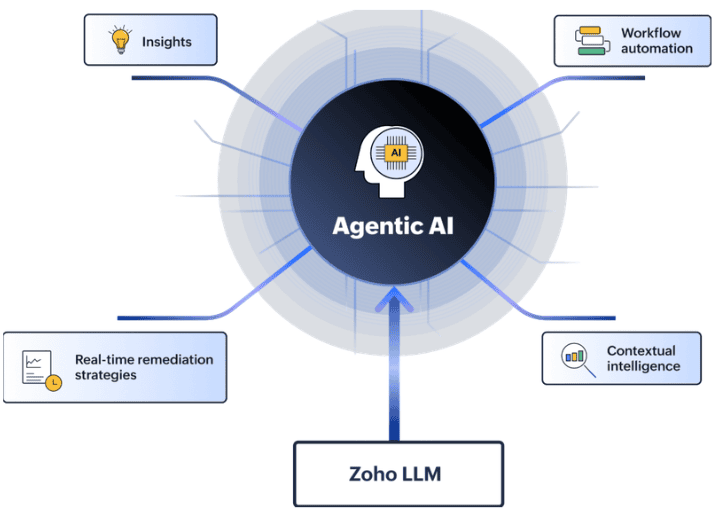
At the heart of Zoho’s 2026 acceleration is its proprietary Zia stack. In a move to ensure data privacy and performance, Zoho decoupled from third-party AI providers to build an in-house model library optimized for business context.
Right-Sized Model Architecture
Zoho’s "Right-Sized" philosophy utilizes specialized models rather than a singular, expensive monolithic AI. This approach ensures that compute resources are used efficiently, leading to a direct reduction in "Inference Tax."
Zia-Lite (1.3B Parameters): Dedicated to high-speed tasks such as real-time sentiment analysis, email triaging, and data extraction.
Zia-Pro (2.6B Parameters): Optimized for complex workflow orchestration, SQL query generation, and cross-app data mapping.
Zia-Ultra (7B Parameters): A multi-modal model capable of processing visual data, conducting financial audits, and performing long-range strategic forecasting.
The most tangible manifestation of Zoho’s AI in 2026 is the Zia Agent Studio. This no-code/low-code environment allows businesses to create "Digital Employees" that live within their CRM, Desk, or Books accounts. Zoho has launched a marketplace featuring over 700 pre-configured actions. These are not simple integrations; they are "Skills" that an agent can learn. For example, a Revenue Growth Specialist agent can independently analyze historical sales data, identify a 15% drop in customer retention within a specific demographic, and automatically launch a re-engagement campaign via Zoho Campaigns. The "Acceleration" provided by Zoho is measured across multiple dimensions: speed, accuracy, and scalability. Analysis by McKinsay suggests that organizations integrating agentic AI see productivity gains of up to 40% within the first 12 months.
Comparative Efficiency Matrix
Operational Metric | Manual / Legacy Process | Zoho Agentic AI (2026) | Erphub Acceleration Impact |
Lead Qualification | 24 - 48 Hours | < 2 Minutes (Autonomous) | $95% reduction in response time. |
Customer Support | 4 - 8 Hour Resolution | Instant (Self-Service Agents) | $70% lower cost per ticket. |
Financial Closing | 7 - 10 Days | < 4 Hours (Self-Auditing) | Eliminates month-end stress. |
Content Creation | 5 Hours (Avg. Post) | 30 Seconds (Context-Aware) | increase in output volume. |
Data Integrity | $80% Accuracy (Human) | $99.5% Accuracy (AI-Vetted) | Prevents costly decision errors. |
Interoperability and the Model Context Protocol (MCP)
In 2026, silos are functionally extinct. Zoho’s implementation of the Model Context Protocol (MCP) allows Zia Agents to communicate with third-party agents (such as those from Salesforce or Microsoft). This ensures that if a client uses a multi-vendor stack, the "Intelligence" remains fluid. Erphub specializes in this "Cross-Platform Orchestration," ensuring that your Zoho-based agents can retrieve data or trigger actions in any external ERP or legacy system without manual intervention.
Technology alone does not accelerate a business; it is the Orchestration of technology that creates a competitive advantage. Erphubhas developed a robust methodology for deploying Zoho’s 2026 AI capabilities.
The "Intelligence First" Audit
Before any code is written, Erphub performs a comprehensive audit of your "Information Architecture." We identify where your data is fragmented and where "Friction Points" exist. We don't just automate your current process; we redesign it to be AI-native.
Custom Agent Sculpting
Using the Zia Agent Studio, Erphub "sculpts" agents specifically for your unique business logic. We train these agents on your specific customer personas, pricing strategies, and service protocols. This results in a "Digital Workforce" that speaks your brand voice and understands your specific market nuances.
As we move deeper into the decade, the divide between "Accelerated" businesses and "Legacy" businesses will become an insurmountable chasm. Zoho’s 2026 AI capabilities provide the tools to bridge this gap, but the complexity of implementation requires a partner who understands both the technical "How" and the strategic "Why."