AI-powered data cleaning represents a specialized branch of data engineering that utilizes artificial intelligence (AI), machine learning (ML), and natural language processing (NLP) to autonomously identify and rectify errors within large-scale datasets. In the contemporary digital economy, where information has been termed the "new oil," unrefined or "dirty" data acts as a systemic pollutant, eroding organizational value and leading to catastrophic financial miscalculations. Within the architectural framework of the Zoho Corporation, this process is executed through a sophisticated ETL (Extract, Transform, Load) engine known as Zoho DataPrep, supported by the cross-functional intelligence of Zia. For the clients of Erphub, the implementation of these automated pipelines is no longer a peripheral IT concern but a fundamental strategic imperative for ensuring the success of Business Intelligence (BI) and predictive modeling initiatives.
Historically, the discipline of data management was characterized by a manual, reactive approach where analysts spent an estimated 80% of their total project time simply identifying and correcting errors within spreadsheets or legacy databases. This phenomenon, often referred to as "Data Wrangling," represented a massive drain on intellectual capital and significantly delayed the "Time-to-Insight." As businesses in 2025 transition into hyper-connected entities, the volume of data generated by CRM systems, e-commerce platforms, and IoT sensors has exceeded human processing capacity. This leads to a state of Information Entropy, where the disorder within a data system increases over time, eventually rendering the data unusable for decision-making.
The economic ramifications of this entropy are profound. Research conducted by Gartner suggests that poor data quality is responsible for an average annual loss of $12.9 million per organization, a figure that includes wasted marketing spend, regulatory non-compliance fines, and missed sales opportunities. Consequently, the shift toward an automated, AI-driven model is a response to the "Data Debt" accumulated over decades of siloed information management. Zoho's approach to this problem is uniquely multi-dimensional, offering a "Self-Cleaning" environment where data is profiled, transformed, and enriched automatically before it ever reaches an executive dashboard.The first fundamental pillar of this topic is the technical transition from periodic, manual "cleansing" to continuous, autonomous data pipelines. In the legacy paradigm, data cleaning was treated as a one-time event—often performed just before an annual report or a major system migration. This approach was flawed because data begins to decay the moment it is entered. AI-powered solutions like Zoho DataPrep redefine this by treating data as a flowing resource. Through the integration of Zoho Flow and Zia, businesses can establish "Always-On" pipelines that ingest raw data from multiple sources (SQL databases, cloud storage, or Excel files), apply complex cleaning logic in real-time, and output "Gold Standard" data directly into Zoho Analytics.
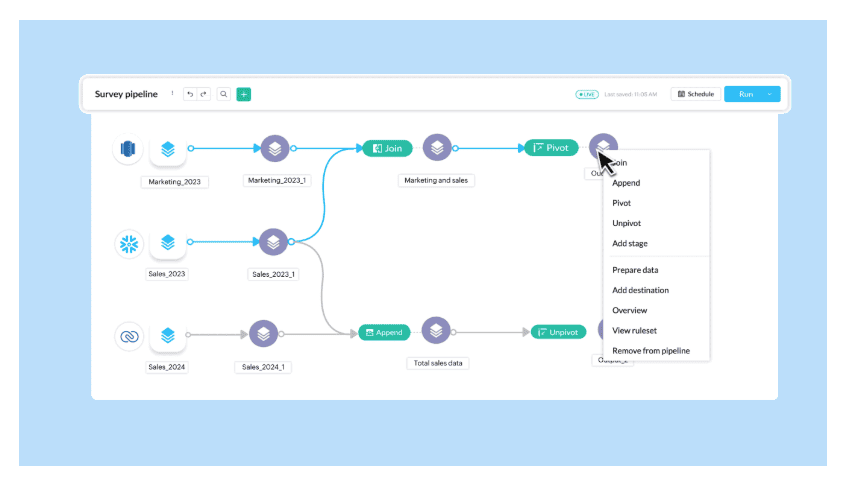
The novelty of Zoho’s AI lies in its ability to perform Automated Data Profiling. When a dataset is ingested into Zoho DataPrep, the system does not wait for user input; instead, it immediately executes a comprehensive scan to determine the "Health Score" of the information. Using machine learning algorithms, the system identifies Outliers—values that deviate so significantly from the statistical norm that they likely represent sensor malfunctions or human entry errors. For instance, if a sales record in Zoho CRM indicates a transaction date in the year 2099, Zia flags this as an anomaly and suggests a corrective transformation based on historical patterns. This level of pattern discovery is impossible at scale for human teams but is executed in milliseconds by the Zoho engine.
Transform by Example (TBE) and Natural Language Orchestration
A major barrier to advanced data preparation has traditionally been the requirement for specialized technical knowledge, such as the ability to write complex Regular Expressions (Regex) or SQL scripts. Zoho has neutralized this barrier through Transform by Example (TBE). This technology allows a user to provide a single example of how a piece of data should look—for example, converting varied phone formats into a standardized international E.164 format—and the AI infers the underlying logic to apply it across millions of records. Furthermore, the 2025 integration of Generative AI allows users to interact with their data using natural language. Through "Ask Zia," an administrator can simply type, "Remove all duplicate leads where the email address is the same but the company name is slightly different," and the system generates the deduplication logic autonomously.
In the marketing dimension, data integrity is the primary driver of Hyper-Personalization. If a marketing database contains inconsistent or duplicate records, a customer might receive multiple conflicting emails, or worse, emails addressed with incorrect data (e.g., "Dear [FIRST_NAME]"). This not only wastes ad spend but actively damages brand equity. AI-powered preparation ensures a "Single Source of Truth," where every customer touchpoint is informed by a clean, unified profile. This leads to higher conversion rates and a measurable increase in Customer Lifetime Value (CLV). Organizations using Zoho's automated cleaning have reported up to a 30% improvement in campaign engagement simply by ensuring the data fed into Zoho Campaigns was accurate.
Financial Integrity and Regulatory Compliance
From a financial perspective, streamlined data preparation is a requirement for Fiscal Orchestration. Inconsistent currency formats, misaligned date fields, or duplicate invoices can lead to devastating errors in financial reporting. The Mars Climate Orbiter disaster of 1999—a $125 million loss caused by one system using English units and another using metric—remains the ultimate cautionary tale of data preparation failure [Source: NASA JPL]. In the modern enterprise, Zoho DataPrep prevents these "metric-mismatch" errors by automatically standardizing units of measure and currency across global operations. Furthermore, the system provides a comprehensive Data Lineage report, which is essential for audits under SOX or GDPR, as it proves exactly how data was transformed from its raw state to its final reported state. The final pillar of this analysis is the architectural advantage of the Zoho One ecosystem. Unlike third-party data cleaning tools that require complex API integrations and constant maintenance, Zoho DataPrep is natively woven into the fabric of the suite. This creates a "Closed-Loop" data environment. When data is cleaned in Zoho DataPrep, the results are instantly available in Zoho CRM, Zoho Books, and Zoho People. This synthesis ensures that "Data Hygiene" is not an isolated task performed by a data scientist but a continuous background process that supports every employee in the organization.
Zero-Trust Data Governance and Private AI
A major concern for Erphub’s potential clients is the security of their data during the cleaning process. Many public AI tools train their models on the data provided by users, creating a massive intellectual property risk. Zoho distinguishes itself through its commitment to Private AI. The machine learning models used in Zoho DataPrep are proprietary and operate within the user's secure tenant. This means that while the AI gets smarter at recognizing your data patterns, your proprietary information never leaves the Zoho ecosystem. This security posture is bolstered by Role-Based Access Control (RBAC), ensuring that only authorized personnel can view the raw, unmasked data during the transformation process.
The Erphub Implementation Methodology: Achieving Operational Excellence
The transition from a manual data culture to an autonomous one requires more than just software; it requires a structural overhaul of the data lifecycle. Erphub (www.erphub.com) serves as the strategic architect in this transformation. The Erphub methodology focuses on building "Intelligent Workflows" where data preparation is triggered by business events. For example, when a new lead is captured via a web form, the Erphub-configured Zoho system can automatically:
Verify the email address and phone number for validity.
Clean the company name (removing "Inc" or "Ltd" for standardization).
Enrich the record with industry data via AI lookup.
Push the "clean" record to the CRM for immediate sales action.
In conclusion, AI-powered data cleaning and preparation is the silent engine that drives the modern, data-native enterprise. By eliminating the manual friction of data wrangling, businesses can redirect their human capital toward high-value analysis and strategic growth. The Zoho ecosystem, orchestrated by the expertise of Erphub, offers the most comprehensive and secure platform for achieving this state of "Autonomous Integrity." In the landscape of 2025, the competitive divide will be defined by those who act on clean data and those who are paralyzed by the "noise" of information entropy.