AI-driven client interaction is a specialized domain of business process management that utilizes artificial intelligence (AI), machine learning (ML), and natural language processing (NLP) to mediate, enhance, and optimize the relationship between a firm and its clientele. In the 2025 landscape, this paradigm has evolved from simple rule-based chatbots to "Agentic AI"—autonomous digital entities capable of complex decision-making. Within the global enterprise market, the Zoho Corporation has emerged as a primary provider of these capabilities through its integrated AI assistant, Zia, and its proprietary Large Language Models (LLMs). The implementation of these solutions represents a transition from manual, reactive administration to a state of Proactive Cognitive Orchestration.
This low-friction setup is strategically engineered to mitigate a primary risk in MarTech implementation — the failure to properly plan integrations and the subsequent error-prone rushing of timelines. By reducing the complexity of the initial data pipeline setup, the platform dramatically accelerates the time-to-value for the investment. Furthermore, the design inherently respects fundamental consumer expectations: studies indicate that loyalty program engagement is highly dependent on ease of use (77% consensus) and the clear ability to track benefits (67%). The system addresses this with its fully customizable Loyalty Widget, which integrates directly into the online storefront, allowing customers to easily track their status, manage points, and redeem rewards with minimal friction, thereby ensuring high adoption rates and program participation. Rewarding customers for actions such as submitting reviews or referrals is an intentional architectural decision that shifts the program's strategic focus toward generating proprietary data assets and cultivating active brand advocates, laying the groundwork for a truly robust and sustainable retention strategy.
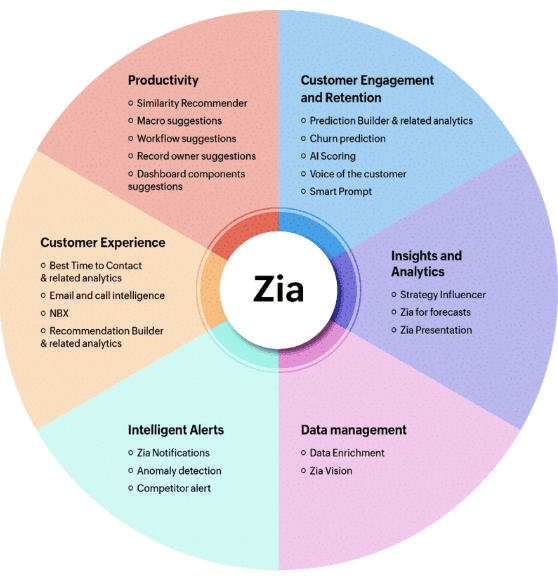
The history of client interaction is traditionally divided into three eras: the Manual Era (physical records), the Digital Era (static CRMs), and the current Cognitive Era (AI-mediated). As of 2025, the volume of digital signals—comprising emails, social media mentions, live chats, and telephony—has surpassed human cognitive limits. Research indicates that by the end of 2025, approximately 95% of customer interactions will be assisted by AI in some capacity. The most significant development in this era is the rise of Zia Agents. Unlike early chatbots that were restricted to "if-then" logic, these new agents operate as "Digital Employees." They possess the autonomy to query databases, interpret sentiment, and execute multi-step workflows across the Zoho suite without human intervention. This shifts the role of the human employee from a "data processor" to a "strategy supervisor."
Predictive Customer Intelligence
The first fundamental pillar of AI-driven interaction is the transition from historical reporting to foresight-driven engagement. In a traditional model, a business knows what a customer did; in an AI-driven model, the business knows what the customer is likely to do. This dimension is primarily powered by Zoho’s predictive engine within Zoho CRM and Zoho Analytics.
Lead Scoring and Win Probability
Zia analyzes thousands of historical data points to assign a Win Probability to every deal in the pipeline. This is not a static number; it fluctuates in real-time based on the customer’s behavior—such as the velocity of email replies or the specific pages visited on a corporate website.
Best Time to Contact and Anomaly Detection
Perhaps the most "novel" application of Zoho's AI is the Best Time to Contact algorithm. Zia monitors a specific lead's digital footprint across all Zoho apps and suggests the exact hour and day a sales rep should reach out to maximize the chance of an answer. Furthermore, Zia’s Anomaly Detection acts as a fiscal and operational "smoke detector." If a high-value client suddenly stops engaging or if ticket volume spikes in a specific region, Zia alerts management immediately, allowing for a proactive "save" before churn occurs. The second pillar is the creation of a frictionless front-end where AI handles the majority of initial client touchpoints. This is primarily facilitated by Zoho SalesIQ and the recently unveiled Zia Agent Studio.
From Chatbots to Zobots and Answer Bots
The traditional "frustrating" chatbot has been replaced by the Answer Bot, which is natively integrated with a company’s Knowledge Base. Using Zoho’s in-house LLMs, the Answer Bot no longer just provides links to articles; it reads the articles, understands the context, and generates a human-like summary tailored to the user's specific question. This technology allows businesses to resolve up to 90% of routine queries without a human agent, achieving a near-instantaneous First Response Time (FRT).
Multilingual and Omnichannel Fluidity
In the globalized economy of 2025, AI-driven interaction must be language-agnostic. Zoho’s AI supports over 40 languages, providing real-time translation and sentiment analysis across WhatsApp, Telegram, Facebook Messenger, and Live Chat. This ensures that a business in the United States can provide high-quality, localized support to a customer in India or Brazil without the overhead of local staffing.
Zia Agent Studio: Building the Digital Workforce
The most groundbreaking shift for Erphub clients is the ability to build custom AI agents. Through the Zia Agent Studio, a business can define a "Job Description" for an AI agent—such as a "Sales Development Representative" (SDR) or a "Resolution Expert." These agents can handle objection handling, meeting scheduling, and even price negotiations, only escalating to a human when the complexity reaches a predetermined threshold.
The final pillar is the unified data model. AI-driven interaction is only effective if the AI has access to the entire customer journey. Zoho’s unique advantage is its "Full-Stack" nature; the AI that talks to a customer in Zoho SalesIQ is the same AI that tracks their payment history in Zoho Books and their support history in Zoho Desk. In Zoho Desk, Zia uses NLP to perform real-time Sentiment Analysis. If an incoming ticket is detected to have "Negative" or "Frustrated" sentiment, Zia can automatically escalate the priority and route it to a senior manager. This "Cognitive Triaging" ensures that human empathy is applied exactly where it is needed most, while routine tasks remain automated. After a transaction or support case is closed, Zia continues to work. It summarizes the interaction, auto-tags the key topics, and updates the customer profile. These "Zia Insights" are then fed back into the marketing engine. For example, if a client frequently asks about a specific feature, the marketing AI can automatically send them educational content or a targeted up-sell offer related to that feature. The implementation of Zoho’s AI suite delivers measurable economic benefits. The following table provides a comparative analysis of traditional vs. AI-driven client interaction models.
The Competitive Necessity of Integrated AI
In the current era of "Cognitive Commerce," AI-driven client interaction is the primary differentiator between market leaders and those facing stagnation. By utilizing the Zoho Ecosystem, businesses gain more than just a chatbot; they gain a self-improving intelligence layer that optimizes every touchpoint of the customer journey.
The complexity of these systems, however, requires an expert architect. Erphub provides the technical bridge, ensuring that your AI strategy is not just a "feature drop" but a holistic platform shift. By unifying your Sales, Marketing, and Support into a single intelligent lifecycle, Erphub enables you to achieve a level of personalization and speed that was previously the sole domain of multi-billion dollar corporations.